Case Study: Company Thought Leader Profile for Industry Journal
Image by ChatGPT 4
Overview
Our team had the opportunity to write a series of articles profiling the leadership of our company’s training center (SEL University). This article was crafted with the intention of celebrating our distinguished dean and showing readers the kind of exceptional career possible to someone who chooses to pursue the lifelong study of power engineering.
| Request | Celebrate thought leader; promote company trainings |
| My roles | Interviewer, Writer |
| Timeline | 1 month |
| Result | Published in industry journal |
Process
- Pitch article idea to Marketing Manager and obtain approval
- Pitch article to Mr. Altuve and obtain approval
- Read everything I could find on Mr. Altuve
- Craft interview questions
- Provide the interview questions to Mr. Altuve in advance
- Schedule a time and place to interview Mr. Altuve
- Conduct the interview and ask follow-up questions
- Obtain word count guidance from publication
- Write first draft
- Review and iterate
- Request Mr. Altuve to review article and give feedback/approve
- Submit final copy to supervisor
- Obtain SME, publication manager, and company president reviews and approvals
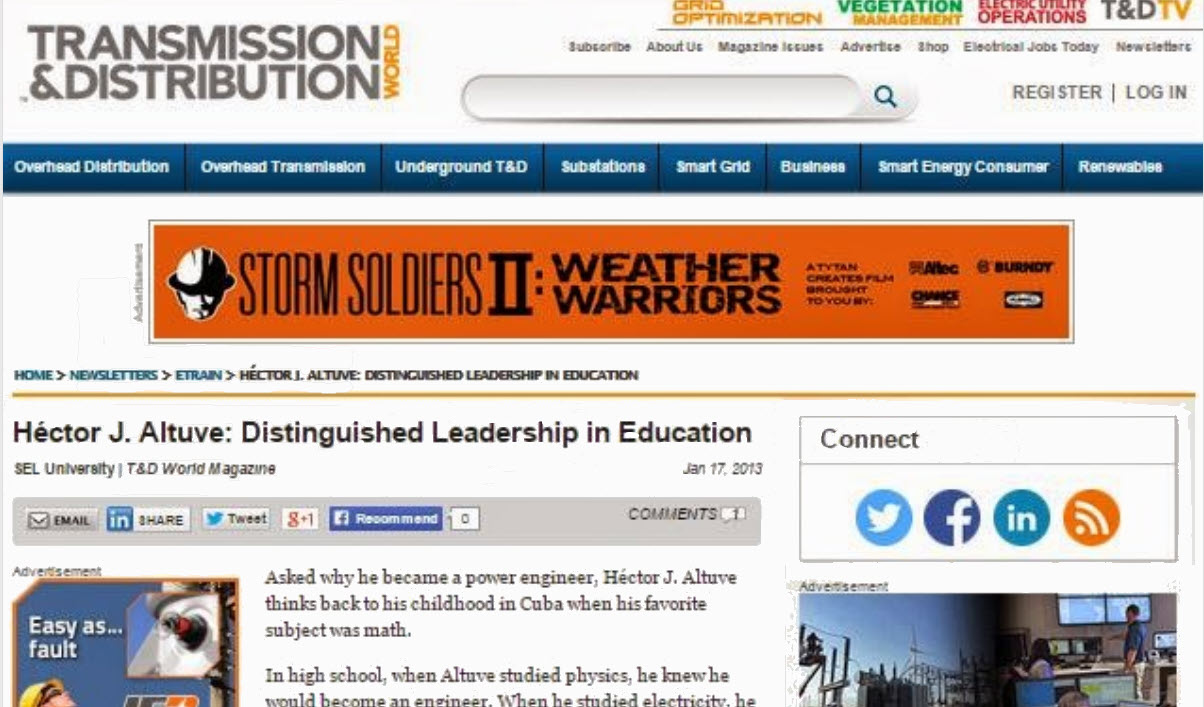
Profile Copy
Héctor J. Altuve: Distinguished Leadership in Education
First published in January 17, 2013, issue of Transmission and Distribution‘s online newsletter, eTrain
By Joanna Hofer
Asked why he became a power engineer, Héctor J. Altuve thinks back to his childhood in Cuba when his favorite subject was math.
In high school, when Altuve studied physics, he knew he would become an engineer. When he studied electricity, he knew he would become an electrical engineer.
“It was that simple,” says Altuve, smiling. “There was never a doubt.”
Altuve attributes much of his success to excellent teachers and professors. This could be why, as Altuve continues to advance in his profession, he is always giving back. The natural trajectory of his career seems to have been guided by an inner need to serve others. For this reason, the success and accomplishments of one man have had far-reaching effects, significantly improving the educational opportunities for power engineering students in Latin America. Now, with his recent appointment as the first dean of SEL University (SELU), Altuve is using this new opportunity to improve power engineering education for a broader range of students than ever before.
In Cuba in the late 1960s, power engineering professors were not required to hold doctorate degrees. So after Altuve graduated from the Central University of Las Villas with a bachelor’s in electrical engineering, he immediately began teaching and researching at the university. He would remain employed there for 24 years.
Altuve lacked only one thing.
“To work as an engineer, I needed experience at a utility,” Altuve says. This experience, unfortunately, was not available as part of his university studies.
So whenever he could, in addition to teaching at the University of Las Villas, Altuve taught courses and worked as a consultant for the national Cuban utility to gradually build up his real-world experience.
In 1977, Altuve enrolled in the Polytechnic Institute in Kiev, Ukraine, USSR. “Kiev is a beautiful city,” Altuve remembers. “The Polytechnic Institute let me continue my research on power system protection that I had started at the Central University of Las Villas.”
When he earned his Ph.D. in 1981, Altuve became the first person in Cuba to hold a Ph.D. in Power Engineering with an emphasis in protection. He was now prepared to accomplish larger goals, and upon his return to Cuba, Altuve created a power system protection program at the Central University of Las Villas, opening the way for more students to learn about power engineering.
“The five Ph.D. students I advised in Cuba are now power system protection professors,” says Altuve, clearly pleased with the accomplishments of his students.
In 1989, Altuve traveled to Monterrey, Mexico, to learn about the Ph.D. program at the Autonomous University of Nuevo León. After he learned there were no doctorate degree holders in power system protection in Mexico, he started a power system protection group within the Ph.D. electrical engineering program at the Autonomous University of Nuevo León, where he was appointed full professor and graduated three Ph.D. and four master’s students in power system protection.
Because he was aware that Latin American engineering students still lacked opportunities to gain practical experience in engineering, Altuve created the Iberoamerican Symposium on Power System Protection as a way to build relationships between universities and industry. The first symposium was held in Cuba in 1991 after Altuve convinced the Central University of Las Villas and the national Cuban utility to be cosponsors. Two years later, in 1993, the second symposium was held in Monterrey, Mexico, with Comisión Federal de Electricidad (CFE) and the Autonomous University of Nuevo León cosponsoring the event. The symposium has been meeting ever since. The eleventh symposium is planned for 2013 and is expected to draw attendees from all over Latin America, Spain, and Portugal as well as vendors from around the world.
The 1993 Iberoamerican Symposium was not only a significant step in building relationships between Latin American universities and industry, it was also a defining moment in Altuve’s career. It was at this event that he made the acquaintance of Dr. Edmund O. Schweitzer, III, the founder and president of Schweitzer Engineering Laboratories, Inc. (SEL), and inventor of the world’s first digital distance relay.
“The first time I met Dr. Schweitzer,” Altuve remembers, “was when I picked him up from the airport in Monterrey for the 1993 Symposium. I learned about Dr. Schweitzer’s work and about SEL from reading technical publications and was impressed by their product innovations.”
A mutual respect quickly developed between the two men, and in 1999, Altuve was awarded the Washington State University (WSU) Schweitzer Visiting Professorship for the academic year of 1999–2000. During this time, Altuve taught two courses and worked on research for SEL, which included the development of the Alpha Plane element and research on transformer differential protection and distribution system ground fault detection.
After completing his visiting professorship at WSU, in January 2001 Altuve accepted a job from SEL as a researcher based in Monterrey. During this time, he developed the Fundamentals SELU courses, including PROT 401, PROT 403, PROT 407, and PROT 409. Altuve would have continued this work but was asked instead to run the then small SEL Mexico subsidiary. Altuve accepted this new challenge, which included building a manufacturing operation from the ground up and serving as Director General of SEL Mexico for the next five years.
In 2005, Dr. Schweitzer appointed Altuve to the position of Distinguished Engineer, the second such position in the company’s history. The first was held by Stanley E. Zocholl, who passed away in 2012.
As Distinguished Engineer, Altuve continues to conduct research for SEL. He recently coedited with Dr. Schweitzer the SEL book, Modern Solutions for Protection, Control, and Monitoring of Electric Power Systems, and is currently working on the Spanish translation.
A world traveler fluent in three languages (Spanish, English, and Russian), a power engineering professor, Director General of SEL Mexico, Distinguished Engineer, researcher, and writer—what could be next for Altuve?
In March 2012, Altuve was the obvious choice to serve as the first Dean of SEL University (SELU). As Dean, Altuve is in charge of all technical material presented in SELU courses and will supervise the SELU instructors, who will be based not only throughout the United States, but around the world.
“Modern protection, control, and monitoring technology is changing very, very fast,” says Altuve. “Practicing engineers are extremely busy, so they don’t have time to keep up with these changes. SELU courses, including Fundamentals and Applications courses, help them get up to speed—to get the knowledge they need to do their jobs better.”
SEL University offers a wide range of instructor-led and e-learning courses on protection, control, and monitoring of utility and industrial electric power systems.
“We get a lot of positive feedback from the students,” says Altuve. “They typically recommend SELU to their colleagues. They know SELU courses are high-quality courses, taught by very knowledgeable instructors with a lot of practical experience.”
Even so, Altuve has many ideas for improvement. Currently, he is in the process of creating a set of new courses, which include new Fundamentals courses as well as Applications courses for new products like the SEL ICON™ and SEL Axion®. Going forward, every new SEL product will have a supporting, associated course. Altuve is also updating all of the courses that SELU currently offers. To do this, he is enlisting the help of numerous SEL employees, including R&D, Engineering Services, and field application engineers.
“Most of our teaching is done by engineers employed by SEL who volunteer their time to SELU,” Altuve says. “Students love having the same people teach them who are designing the products or engineering solutions, or supporting the application of products.”
Altuve’s teaching philosophy is simple. He seeks to involve every student in the class and help them ask questions and interact with the material.
“I like seeing the students’ bright eyes,” says Altuve, “letting me know they are learning. I enjoy having the possibility to help others learn about this fascinating field. This is a blessing.”
Altuve has come a long way from being a kid in Cuba who liked math. From his hard work, dedication, and diligence, he has created opportunities for many people and, in turn, has helped improve the knowledge of power systems and the protection, control, and monitoring technology for countless others.
 Joanna Hofer